

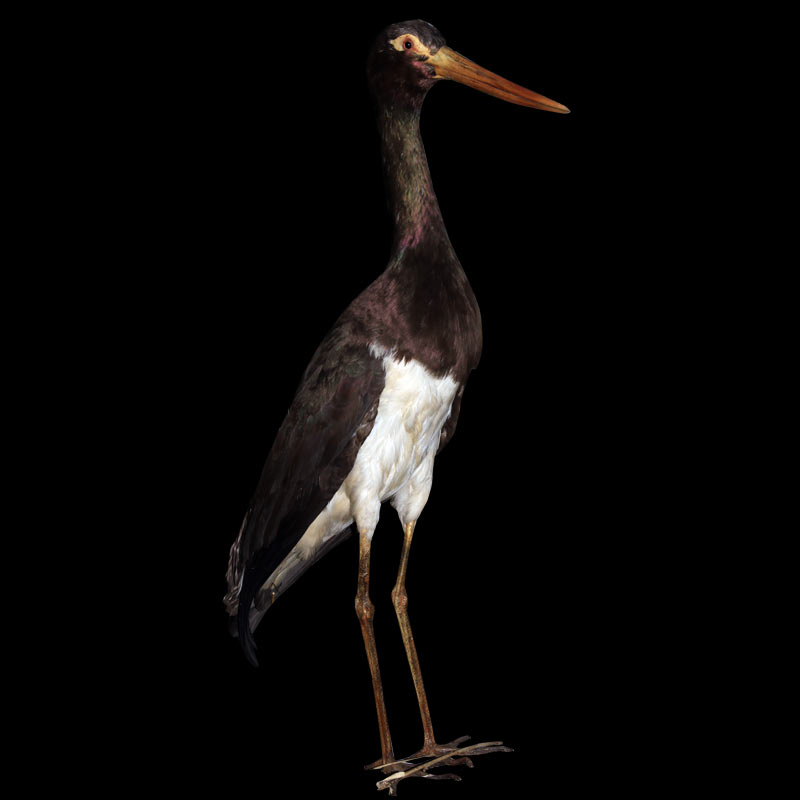
Black stork
CICONIA NIGRA
Information
The nest is large, constructed from sticks and twigs, and sometimes also large branches, at an elevation of 4-25 m (13–82 ft). The black stork prefers to construct its nest in forest trees with large canopies where the nest can be built far from the main trunk - generally in places far from human disturbance. The black stork mainly eats fish, including small cyprinids, pikes, roaches, eels, budds, perches, burbots, sicklebacks and muddy loaches. It may feed on amphibians, small reptiles, crabs, mammals and birds, and invertebrates such as snails, molluscs, earthworms, and insects like water beetles and their larvae.
| DISTRIBUTION | During the summer, the black stork is found from Eastern Asia (Siberia and northern China) west to Central Europe, reaching Estonia in the north, Poland, Lower Saxony and Bavaria in Germany, the Czech Republic, Hungary, Italy and Greece. |
|---|---|
| HABITAT | The black stork prefers more wooded areas than the better-known white stork, and breeds in large marshy wetlands with interspersed coniferous or broadleaved woodlands, but also inhabits hills and mountains with sufficient networks of creeks. |
| CONSERVATION STATUS | … |

 English
 Bulgarian