

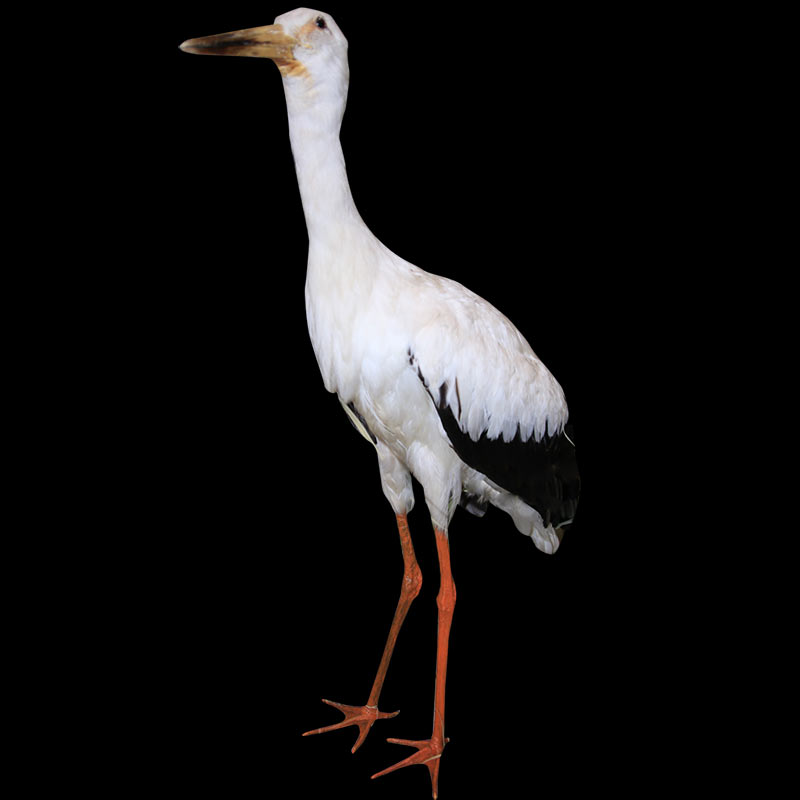
White stork
CICONIA CICONIA
Information
A carnivore, the white stork eats a wide range of animal prey, including insects, fish, amphibians, reptiles, small mammals and small birds. It takes most of its food from the ground, among low vegetation, and from shallow water. It is a monogamous breeder, but does not pair for life. Both members of the pair build a large stick nest, which may be used for several years. Each year the female can lay one clutch of usually four eggs, which hatch asynchronously 33–34 days after being laid. Both parents take turns incubating the eggs and both feed the young. The young leave the nest 58–64 days after hatching, and continue to be fed by the parents for a further 7–20 days.
| DISTRIBUTION | The nominate race of the white stork has a wide although disjunct summer range across Europe, as well as parts of western Asia. |
|---|---|
| HABITAT | The white stork's preferred feeding grounds are grassy meadows, farmland and shallow wetlands. It is building a large stick nest in trees, on buildings, or on purpose-built man-made platforms. |
| CONSERVATION STATUS | … |

 English
 Bulgarian